
Markham Pool Enclosure Bylaw: What to Know Before You Build a Pool
Markham pool enclosure bylaw explained: fence height, gates, temporary fencing, inspection and what the City publishes on fees. Plan before you build a pool.
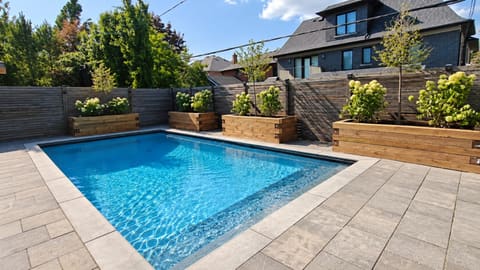
The Markham pool enclosure bylaw decides much more of a pool project than most homeowners expect. Before the excavator arrives, the City of Markham expects a temporary fence, an approved plan for the permanent fence, and an inspection before any water goes into the pool. Understanding that sequence early keeps a pool build on schedule and avoids expensive changes to a fence that has already been installed.
This guide summarizes what the City of Markham publishes today about pool enclosures, permit steps, temporary fencing and inspections. It is general information, not legal advice, and Markham's Building Standards department has the final say on any specific property. Markham has its own rules, so do not assume that Toronto, Vaughan or Richmond Hill requirements apply.
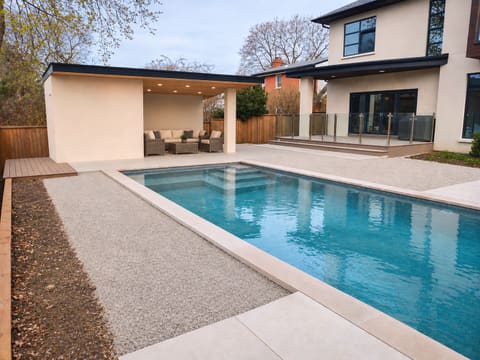
What the Markham pool enclosure bylaw covers
Markham regulates pool fencing through Swimming Pools By-law 2015-96, which the City describes as a by-law "to regulate the enclosures for privately-owned outdoor pools." Its general rule is that every owner of a pool must erect and maintain an enclosure around the entire pool area so that the pool is not readily accessible.
According to the City's fences and swimming pools page, the rule applies to any pool, above-ground or in-ground, where the water depth can exceed 0.6 m (24 in.). The enclosure must be at least 1.2 m (4 ft) high and in place before the pool is filled. The same page states that homeowners who contravene any part of the by-law can be fined up to $5,000.
The City's separate fence by-law (277-97) governs ordinary property fences, while pool enclosures follow the pool by-law, which also covers hot tubs with specific exemptions described below.
The Markham pool permit process, step by step
The City treats the pool enclosure as its own permit. According to Markham's Guide to Building Permits, a Pool Enclosure permit applies to the installation of the required fencing around in-ground and above-ground pools on residential properties, and the permit must be obtained prior to the construction of the pool. The City's building permit page also lists "installing or changing a swimming pool fence enclosure" among the work that needs a building permit.
In practice, the published steps look like this:
- Confirm the rules for your lot. Zoning, setbacks and any Conservation Authority requirements are reviewed through the Applicable Law Checklist that accompanies the application.
- Prepare the drawings. The City asks for a site plan prepared from a current survey, showing property lines, existing buildings, the proposed pool, fence details (height, material and location), the clearance between fence and pool, gate locations and, where relevant, the septic system.
- Gather the forms. The City's list includes the Swimming Pool Enclosure Application form, the Applicable Law Checklist, the Swimming Pool Letter of Undertaking, and a utilities clearance stamped approved by Alectra.
- Submit through ePLAN. The City states that all applications must be submitted online through its ePLAN portal. Paper applications are no longer accepted.
- Review. Markham publishes a target of 10 business days for the first review cycle of pool enclosure permits. Targets are not guarantees, and incomplete submissions are not processed.
- Inspection before filling. The by-law prohibits placing water in the pool until the enclosure has been inspected and approved.
Fees: what Markham publishes
Markham's fee schedule is updated annually, so treat any figure as the amount published at the time you read it. As published in November 2026 on the City's fee schedule page (summarized from Schedule A of Building By-Law 2025-121), a general pre-application review fee of $100 applies, and the City's permit process page describes it as a non-refundable fee payable before drawings can be uploaded in ePLAN.
The fee schedule summary we reviewed does not list a stand-alone residential pool enclosure fee. The "Outdoor Pool" line in the new-building fee table is a different category and should not be assumed to be the cost of a backyard pool enclosure permit. Ask Building Standards at the City for the current fee that applies to your application, and remember that fees change.
Temporary pool fencing in Markham
This is the part homeowners most often overlook. Section 6 of the by-law requires that, during installation, a temporary enclosure encloses the pool or the property and is maintained at all times. The temporary fence must stay in place until an officer has inspected and approved the permanent enclosure.
According to the by-law, a temporary enclosure:
- is 1.2 m (4 ft) high, made of plastic or chain link fence;
- has mesh openings no larger than 38 mm (1.5 in.);
- uses steel embedded T-bar posts at a maximum spacing of 3.0 m (10 ft), with 9 gauge galvanized steel wire at the top and bottom;
- is set at least 1.2 m (4 ft) from the edge of the pool.
An officer may permit alternative temporary fencing that gives equivalent or better protection.
On our pool builds, we supply and install the temporary pool fence, and its cost is built into the project price.
Permanent enclosure standards in Markham
The pool by-law sets out general provisions that apply to wood, metal and chain link enclosures, and then adds material-specific schedules. The headline requirements, as published in the by-law, are:
| Item | Requirement in By-law 2015-96 |
|---|---|
| Minimum height of fence and gates | 1.2 m (4 ft) |
| Maximum height of fence and gates | 1.8 m (6 ft) |
| Minimum distance from the water's edge to the enclosure | 1.2 m (4 ft) |
| Maximum clearance between bottom of fence or gate and grade | 100 mm (4 in.) |
| Maximum vertical or horizontal opening | 100 mm (4 in.) |
| Permitted materials | Wood, metal or chain link |
Other points from the by-law:
- Enclosures must not have bracing or attachments on the outside that would help someone climb them, and objects must not be placed or leaned near the enclosure in a way that makes climbing easier.
- Section 8.5 allows a permanent enclosure built to a different standard if it is equivalent or better and acceptable to the City's manager. If you want a particular modern look, raise it with the City early rather than assuming it will pass.
Gates
Gates must be hung on hinges strong enough for the gate's weight and be equipped with a self-closing device and a lockable self-latching device on the interior face near the top. The by-law defines a self-closing device as one that returns the gate to its closed position within 30 seconds. Double gates need one leaf with the self-closing and self-latching hardware and a securing device on the other. Doors from a garage or other structure directly to the pool area need a bolt or chain latch at a minimum height of 5 ft 6 in. (about 1.7 m) above the inside floor. The by-law also requires gates to be kept locked with a padlock when the pool is not in active use.
Above-ground pools and hot tubs
The by-law includes partial exemptions. An above-ground pool does not need the full fence if the combined height of its exterior sides and any attached guard is between 1.5 m and 2 m (5 ft to 6 ft 6 in.), the exterior is built so it does not facilitate climbing, it is at least 1.2 m (4 ft) from any lot line, and access to the ladder is enclosed with a compliant fence and gate.
A hot tub does not need an enclosure if it has a substantial cover capable of holding 90.72 kg (200 lb) that is locked when the tub is not in use, or if it has a guard that meets the by-law's requirements. Mako designs and builds the bases and surrounds for hot tubs and swim spas; details on what the by-law requires for your specific unit should be confirmed with the City.
Inspections and what to expect
The City's building permit process page explains that all new construction needs inspection by City Building Officials. For a pool project, the points that matter are the by-law's own requirements: the temporary enclosure until the permanent enclosure is approved, and no water in the pool until the enclosure has been inspected and approved.
To avoid delays, keep the temporary fence intact until the permanent one is approved, check the gate hardware and the clearances in the table on site, and leave the pool empty until approval is received.
Planning the pool build around the by-law
A fence is not only a compliance item. It shapes how the finished yard looks and works.
- Layout. The 1.2 m minimum distance from the water's edge to the enclosure affects the size of the pool deck and patio.
- Access. Delivery and lifting of a pool shell, and equipment access, must be confirmed before the pool type is chosen. A temporary fence has to leave a workable route.
- Utilities. Request locates before digging. According to Ontario Dig Authority, a public locate should be requested at least 5 business days before a single-address project, and private lines such as gas to a pool heater need a private locate.
- Trades. Mako doesn't personally hold pool, gas or electrical licences; that work is done by our licensed partner subcontractors.
- Pool type. We recommend fiberglass pools for most Toronto-area backyards; our guide to fiberglass, concrete and vinyl pools explains the reasoning.
For the wider picture of decks, fences and sheds, see our Markham deck, pool and fence permit guide. Our Markham area page lists the services we offer in the city.
Frequently asked questions
What is the minimum fence height for a pool in Markham?
According to the City of Markham, a pool where the water can exceed 0.6 m (24 in.) must be surrounded by a fence at least 1.2 m (4 ft) high before it is filled. By-law 2015-96 also sets a maximum of 1.8 m (6 ft) for enclosure fences and gates.
Do I need a temporary fence while the pool is being built?
Yes. The by-law requires a temporary enclosure during installation, which must stay in place until an officer has inspected and approved the permanent enclosure. It must be 1.2 m (4 ft) high, with mesh openings no larger than 38 mm (1.5 in.), and be set at least 1.2 m (4 ft) from the pool edge. On Mako pool builds, we supply and install the temporary fence as part of the project price.
Can I fill the pool before the fence inspection?
No. The by-law prohibits placing water in a pool until the enclosure has been inspected and approved. Filling early can lead to enforcement action, and the City says anyone who contravenes the by-law can be fined up to $5,000.
What materials can a Markham pool fence be made from?
The by-law allows wood, metal or chain link enclosures built to the relevant schedules. A different design can be accepted if it is equivalent or better and acceptable to the City's manager, so discuss unusual materials with the City before you order.
Is a hot tub covered by the same rules?
Yes, with exemptions. A hot tub does not need an enclosure if it has a substantial locked cover capable of holding 90.72 kg (200 lb), or a guard that meets the by-law. Confirm the details for your unit and layout with the City.
Planning a pool in Markham?
If you are planning a pool and want the fence, deck, patio and landscaping designed as one project, contact Mako Construction to book a consultation. We will talk through your lot, access and budget band before any construction decisions are made.
Sources
- markham.ca/about-city-markham/city-hall/bylaw/fences-swimming-pools
- markham.ca/sites/default/files/about-city-markham/Fences%20&%20Swimming%20Pools/...
- markham.ca/economic-development-business/building-permits/guide-building-permits
- markham.ca/economic-development-business/building-permits/building-permit-proces...
- markham.ca/economic-development-business/building-permits/fee-schedule
- markham.ca/sites/default/files/economic-development-business/ePLAN%2BQuick%2BRef...
- ontariodigauthority.ca/locates-overview/
This guide is general information, not legal or engineering advice. Rules and fees change; confirm requirements for your property with your municipality.

About the author
Stephan Tosevski
Stephan Tosevski leads Mako Construction. Mako Construction has built high-end outdoor living spaces across Toronto & the GTA since 2016 — decks, cabanas, pergolas, landscaping, pools, outdoor kitchens, and hot tub and swim spa installations. Fully insured, with permit-ready projects and professional site management from consultation to turnover.
Related guides
Guide
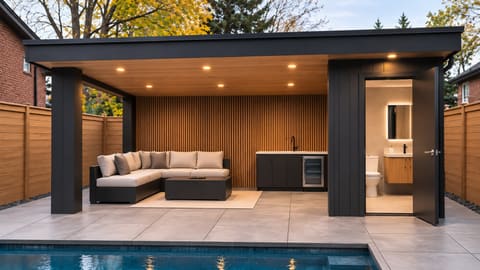
Pool House With a Bathroom: Plumbing, Permits and Layout
Planning a pool house with a bathroom in Toronto? See how plumbing triggers a permit, what zoning allows, and how to lay out the washroom. Read first.
Guide
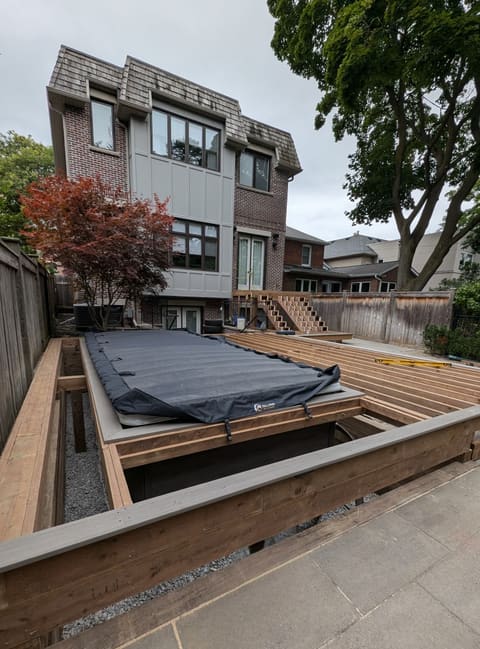
Best Time of Year to Build a Deck or Pool in Ontario
The best time of year to build a pool in Ontario: how winter planning, spring starts, fill rules and booking lead times shape your pool and deck schedule.
Guide
Call Before You Dig in Ontario: Locates for Backyard Projects
Call before you dig in Ontario: how Ontario One Call (Ontario Dig Authority) locates work, what private lines they miss, and how to plan. Read the guide.
Guide
Cabana Ideas for Pools: Layouts for Changing, Storage, Bar and Lounge
Cabana ideas for pools: layouts for changing, storage, a bar and a lounge, plus the planning points that shape a modern pool cabana design.
See also our Pools service.