
Backyard Drainage Solutions for Toronto Clay Soil
Backyard drainage solutions for Toronto clay soil: grading, downspouts, French drains, swales and rain gardens, plus City rules to check. See what works.
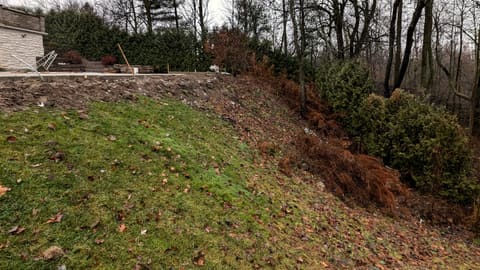
Standing water after every rain is one of the most common backyard complaints in the GTA, and it rarely has a single cause. Backyard drainage solutions work when they follow the water: where it comes from, where it collects and where it can safely go. This guide explains why Toronto clay soil holds water and which fixes suit which problem.
Drainage belongs in every landscape plan, and our landscaping and hardscaping service is where grading, surfaces and water routes come together. The information below is general, and a specific yard may need a site visit or an engineer's advice.
Why clay soil causes backyard drainage problems
Clay soil is made of very fine particles that pack tightly. Water enters it slowly and leaves it slowly, so a heavy rain or a spring thaw can saturate the top layer while the soil below is still full. On a flat lot, the water has nowhere to go but sideways or up.
This is typical of the region. A monitoring study by the Sustainable Technologies Evaluation Program (STEP) described clay loam soils with low infiltration rates as "not uncharacteristic of soil permeability in many other parts of the GTA." The same program found that adding topsoil without reversing subsoil compaction gave only minor runoff reduction.
For a homeowner, that means three things:
- Water sits on the surface longer than it would on sandy soil.
- Drainage that relies on soaking into the ground, such as a pit of gravel, may fill and stay full.
- The grade, the surface and the outlet matter more than the pipe.
Read the yard before choosing a fix
Before you price any backyard drainage solution, find out what kind of water problem you have. The fix for roof runoff is different from the fix for a low corner.
Watch it during a rain
Go outside in a steady rain and note:
- where water leaves the downspouts and which way it travels;
- where it pools, and how many hours or days it stays;
- whether it runs toward the foundation, a neighbour or a walkway;
- whether the lawn is soft, mossy or dying in certain spots.
Check the usual suspects
- Downspouts. Many problems start at the roof. The City of Toronto says it is mandatory for all property owners to have downspouts disconnected from the City's sewer system, with water directed onto the property and away from the foundation.
- Grade at the house. The City advises that grading around a home should slope away from the foundation wall, without negatively affecting neighbouring properties.
- Hard surfaces. Patios, walkways and driveways shed water at a high rate. The City suggests porous pavement and more green space to help absorb rain and melted snow.
- Basement signs. If a basement corner is damp, the City says weeping tiles may not be working and may need repair or replacement.
Backyard drainage solutions that work on clay
No single product solves every yard. Most Toronto lots need a combination, applied in this order.
1. Fix the roof water first
The City describes simple steps: cut and cap the old sewer connection, fit an elbow and an extension to carry water away from the house, and use a splash pad to prevent erosion. Its guidance is that water should flow at least 2 m (about 6 ft 7 in.) from the foundation, not onto a neighbour's property, not onto a sidewalk or driveway, and not across a walkway as a tripping hazard. The City also warns that water flow may freeze in winter, so plan the outlet with that in mind.
2. Correct the grade
Surface grading is the most effective and least visible solution on a clay lot. The aim is a gentle, continuous slope that carries water away from the house and out to a safe outlet. For new infill housing, the City's grading guidance asks for side yards drained at slopes not less than 1.5% to positive drainage outlets, and for the rear yard slope not to exceed 10% where grades are being altered. That guidance is written for infill construction, but the principle holds on any lot: keep water moving, and create no ponding or erosion on your property or the neighbours'.
We will cover this in more depth in our guide to backyard grading.
3. Add a swale or surface channel
A swale is a shallow, planted or stone-lined channel that guides surface water toward an outlet. It works with gravity and needs no pump.
4. Use a French drain where water collects
A French drain backyard system is a trench with a perforated pipe in clean stone, wrapped in filter fabric, that collects water and carries it somewhere. It suits a persistent wet strip or a low corner. Its limits matter on clay:
- It needs a place to send the water, such as a daylight outlet, a swale or a safe discharge point. A drain that dead-ends in clay simply fills.
- It needs a continuous fall along its length.
- The City's grading guidance says storm drainage must not be directed to a sanitary sewer, and an outlet must not push water onto a neighbour.
On our landscaping projects, we design and install French drains, along with grading and swales, so water has a clear path away from the house and patio.
5. Use catch basins and area drains for paved areas
Where a patio or walkway sheds water to a low spot, an area drain connected to a proper outlet takes it away. This is far easier to plan before pavers go down than after.
6. Be careful with soakaways and dry wells
A pit of stone that relies on infiltration is attractive in theory and unreliable on clay. In STEP's evaluation of rear-yard infiltration trenches in a Markham development, at least one of the three trenches did not receive runoff from its drainage area, and the program attributed the very minor runoff reduction to deficiencies in how they were implemented. The lesson is that infiltration features need testing and a path for overflow.
7. Consider a rain garden, with realistic expectations
A rain garden is a planted, sunken area that collects roof or yard runoff and lets it soak in. Toronto and Region Conservation Authority (TRCA) guidance says rain gardens use a special soil mix, usually compost and sand, to a depth of about 60 cm (2 ft), and that when properly constructed the water drains within 48 hours. It also says that if soil is high in clay, a highly functioning rain garden can be challenging, and recommends consulting a landscape professional. TRCA advises keeping rain gardens at least 4 m from a septic bed and 15 m from steep slopes, and it notes that areas of poor drainage are not likely good options without amending the soil.
8. Choose permeable surfaces where they fit
Permeable interlocking pavers over a stone reservoir let water enter the base. STEP's performance evaluation of permeable pavement over clay-loam soil found that, among 71 monitored events, only one produced surface flow, though the installations in that study had a liner and an underdrain that probably helped. On clay, an underdrain with a flow restrictor is typically part of the design.
What not to do
- Do not send water to a neighbour. The City's guidance repeats this point throughout.
- Do not bury a pipe with no outlet. It becomes an underground pond.
- Do not pave over the only place water can soak in without planning where it goes instead.
- Do not skip the locate. Ontario Dig Authority says you must request a public utility locate before you dig, at least 5 business days ahead for a single-address project. Private lines, such as gas to a barbecue or electrical to a shed, are the owner's responsibility and may need a private locate.
Permits and rules to check
Ordinary yard drainage work usually sits outside the building permit system, but several rules still apply:
- The City's building permit page states that a building permit is not required to install a sump pump. It also lists retaining walls more than one metre (3 ft 3 in.) high on or next to public property, building entrances or publicly accessible private property among the work that does need a permit.
- Toronto's downspout disconnection is mandatory, and the City says the work must follow the Property Standards bylaw.
- A basement problem tied to weeping tiles, backwater valves or sump pumps is plumbing work. The City advises hiring a City-licensed plumber.
- The City currently publishes a Basement Flooding Protection Subsidy of up to $6,650 per property for eligible work. Check the program page for current terms.
If your lot backs onto a ravine or sits in a conservation authority regulated area, there may be extra approvals. See our guide to retaining walls in the GTA for how walls and drainage work together on sloped lots.
A practical order of operations
- Observe the yard through a few rainfalls and mark the problem areas.
- Fix roof drainage and downspouts first.
- Correct the grade near the house and along the lot lines.
- Add swales, area drains or a French drain where water still collects.
- Choose surfaces and planting that suit the wet and dry zones.
- Test it with a hose or the next big rain before the final landscaping goes in.
At a site visit, we look at how water moves across your yard, where it collects and where it can safely go, then plan the grading and drains around that.
Frequently asked questions
What is the best drainage solution for a clay soil backyard?
There is rarely one best fix. On clay, the most reliable results come from correcting the grade, moving roof water away from the house and giving surface water a clear outlet. Drains, swales and rain gardens then handle specific low spots. Systems that depend on soaking into the soil alone tend to underperform.
Does a French drain work in clay soil?
It can, if the water has somewhere to go. A French drain collects and carries water; it does not make clay absorb more. It needs a continuous fall and a safe outlet that does not affect neighbours. A drain that ends in a buried stone pit may fill and stay wet in clay.
Why is there standing water in my yard days after rain?
Common causes are a flat or low grade, compacted soil, clay that drains slowly, and roof water released near the ground. Neighbouring runoff or a hard surface directing water to a low spot can also contribute. Watching the yard in a rain shows where the water enters and where it stops.
Can I just extend my downspouts?
Often that is the right first step. The City of Toronto's guidance is to carry water onto your own property, ideally 2 m from the foundation, with a splash pad to prevent erosion. The water must not flow onto a neighbour, a sidewalk or a driveway, and winter freezing should be considered.
Do I need a permit for yard drainage in Toronto?
Most surface drainage work does not require a building permit, and the City says one is not required to install a sump pump. Retaining walls over a set height, work near ravines or conservation areas, and plumbing work can bring other requirements. Confirm with the City before starting.
Dealing with a wet backyard?
If water is pooling in your yard, contact us with photos taken during or just after rain, and a note about where it collects. We will talk through how drainage fits into a full backyard design, so the grading, surfaces and outlets work as one plan.
Sources
- toronto.ca/services-payments/water-environment/managing-rain-melted-snow/basemen...
- toronto.ca/services-payments/water-environment/managing-rain-melted-snow/basemen...
- toronto.ca/services-payments/building-construction/building-permit/before-you-ap...
- toronto.ca/services-payments/building-construction/building-permit/before-you-ap...
- sustainabletechnologies.ca/app/uploads/2013/01/PPBS-Final-2008.pdf
- sustainabletechnologies.ca/home/urban-runoff-green-infrastructure/low-impact-dev...
- watersheds.ca/wp-content/uploads/2023/03/A-Complete-Guide-to-Building-and-Mainta...
- ontariodigauthority.ca/locates-overview/
This guide is general information, not legal or engineering advice. Rules and fees change; confirm requirements for your property with your municipality.

About the author
Stephan Tosevski
Stephan Tosevski leads Mako Construction. Mako Construction has built high-end outdoor living spaces across Toronto & the GTA since 2016 — decks, cabanas, pergolas, landscaping, pools, outdoor kitchens, and hot tub and swim spa installations. Fully insured, with permit-ready projects and professional site management from consultation to turnover.
Related guides
Guide
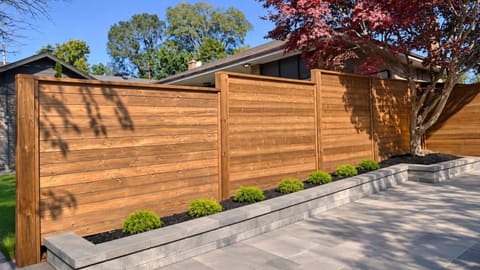
Best Privacy Fence Material for Ontario Winters
Best privacy fence material for Ontario winters: how cedar, composite, aluminum and masonry handle frost, snow and sun, and what to check before you build.
Guide
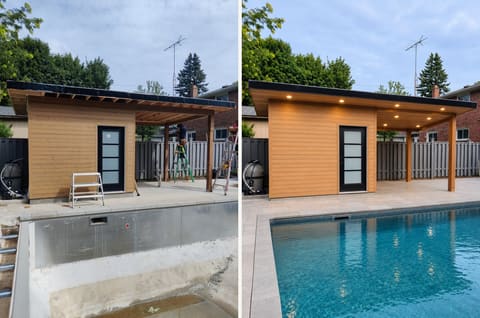
Does a Backyard Upgrade Add Value to a Toronto Home?
Backyard renovation ROI in Toronto: what makes an outdoor upgrade add value, which projects tend to pay back in daily use, and the mistakes that cost you.
Guide
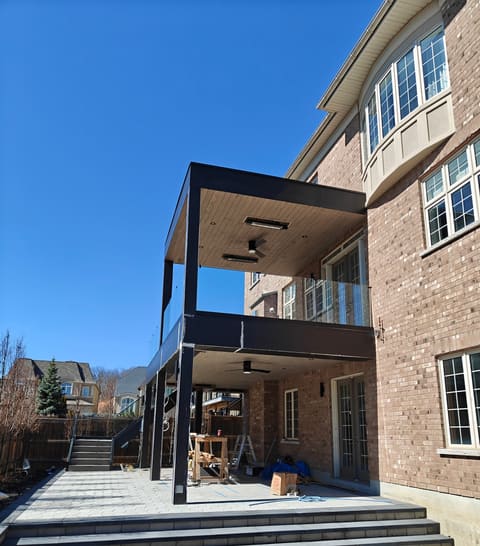
Multi-Level Deck Design for Sloped GTA Lots
Multi level deck design for sloped GTA lots: how to plan levels, steps, guards, footings and drainage so a tiered deck works with your yard. See the checklist.
Guide
Call Before You Dig in Ontario: Locates for Backyard Projects
Call before you dig in Ontario: how Ontario One Call (Ontario Dig Authority) locates work, what private lines they miss, and how to plan. Read the guide.
See also our Landscaping & Hardscaping service.