
Large-Format Pavers vs Interlock: What High-End Patios Use
Large-format pavers, porcelain and natural stone compared with traditional interlock: look, base, joints, freeze-thaw, maintenance and cost drivers.
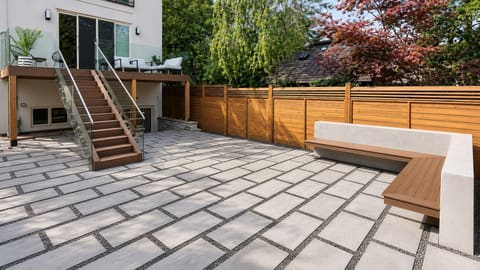
Walk through newer high-end backyards in the GTA and you will notice the change: fewer small, busy interlocking bricks, more large slabs with tight joints and calm, continuous surfaces. Large-format pavers, porcelain and natural stone have become the default for modern patios, and for good reason. But the choice is not purely aesthetic — slab size changes how the base must be built, how joints behave, and what the patio costs. Here is a straight comparison.
See our landscaping and hardscaping page for how we build patios.
What we mean by each
Interlock usually refers to smaller concrete pavers (often brick-sized or a little larger) laid in patterns like herringbone or running bond. The small units lock together through the joints and edge restraints, which is why the system is so forgiving and so widely used on driveways.
Large-format pavers are concrete slabs typically measured in feet rather than inches — think 24" × 24", 24" × 48" and larger. They are installed with narrow joints for a clean, architectural look.
Porcelain pavers are thick, frost-resistant porcelain tiles made for outdoor use, with consistent colour and very low absorption.
Natural stone — granite, limestone, flagstone and others — in sawn slabs or natural shapes, as on the stone walkways and pool surrounds you will see in our project gallery.
Side-by-side
| Interlock | Large-format concrete | Porcelain | Natural stone | |
|---|---|---|---|---|
| Look | Patterned, traditional | Calm, modern | Crisp, uniform | Unique, organic or refined |
| Joints | Many | Few, tight | Few, tight | Varies |
| Base tolerance | Forgiving | Demanding — flatness shows | Very demanding | Demanding |
| Handling | Easy | Heavy; often machine-set | Thin and brittle until set | Heavy; varies |
| Repairs | Easy to lift and reset | Possible; heavy | Replace individual tiles | Possible; matching can be hard |
| Best for | Driveways, budgets, curves | Patios, pool decks, walkways | Contemporary patios, pool decks | Pool surrounds, steps, statement areas |
Why large slabs look better
Fewer joints mean a quieter surface that makes a yard feel larger and lets architecture, planting and furniture stand out. Large slabs also align cleanly with house walls, steps and pool coping, which is why designers like them for modern homes.
Why large slabs are harder to build
The same size that makes them look good makes them unforgiving:
- Flatness. A small paver can rock slightly and nobody notices. A 24" × 48" slab that rocks, or sits a few millimetres proud of its neighbour, is obvious and becomes a trip edge.
- Load spreading. Large slabs bridge small soft spots in the base — until they do not, and crack. The base must be uniformly compacted.
- Handling. Big slabs are heavy and often set with vacuum lifters or clamps. Porcelain is strong once bedded but can break if handled carelessly.
- Cutting. Clean cuts at borders, drains and steps take time and the right tools.
The part you never see: the base
Most patio failures in the GTA come from what is underneath. Freeze-thaw cycles, heavy clay soils and poor drainage push and heave patios that were built on thin or poorly compacted bases.
A durable patio comes down to:
- Excavating to remove organic soil and reach stable subgrade.
- Building up compacted granular base in lifts, compacting each layer — depth depends on soil, use and load.
- Grading for drainage — the surface slopes away from the house and toward a place where water can go.
- Bedding appropriate to the paver type, from screeded bedding to pedestal or mortar-set systems for some porcelain and stone.
- Edge restraint so the field cannot spread.
- Jointing with a material suited to the joint width and product.
Our service description puts it simply: "Grading, drainage & proper base systems." It is the line item most worth paying for.
Freeze-thaw and our climate
Toronto winters bring repeated freeze-thaw cycles. Products rated for freeze-thaw, proper drainage so water does not sit under slabs, and correct joint materials are what keep a patio flat after five winters. Porcelain's very low absorption makes it naturally resistant; concrete and stone depend on product quality and sealing choices.
Heat, slip and maintenance
- Heat. Lighter colours stay cooler on pool decks; dark stone gets hot in full sun.
- Slip. For pool decks and steps, choose textured or flamed finishes rather than polished ones.
- Maintenance. Porcelain resists staining and needs little more than cleaning. Concrete and natural stone may benefit from sealing depending on the product; interlock joints need occasional re-sanding.
Where interlock still makes sense
Interlock is excellent on driveways, curved paths and tight budgets, and it is easy to repair after future utility work. Many yards combine both: large-format slabs on the main patio and pool deck, a coordinating smaller unit on the driveway or side paths.
Before you dig
Excavating for a patio requires a free utility locate through Ontario Dig Authority at least five business days ahead. In Toronto, excavating or grade changes inside the protection zone of a private tree 30 cm or more in diameter require a permit (City of Toronto). Design around mature trees early — it often shapes the patio layout.
Choosing colour and finish
Large slabs show colour more strongly than small units because there are fewer joints to break up the surface. Pick colours in daylight, on site, beside the house cladding and any stone on the home. Lighter, warm greys and limestone tones keep pool decks cooler and make small yards feel larger; darker charcoal tones look sharp against light houses but get hotter in sun. Textured, flamed or brushed finishes give better grip than smooth faces — important around pools and on steps.
Questions to ask your contractor
- What base depth and materials are specified for this soil and use?
- How is the base compacted, and in how many lifts?
- What bedding and jointing system is used for this product?
- How is the patio graded, and where does the water go?
- How are edges restrained?
- Is the product rated for freeze-thaw?
- What warranty covers settlement?
Frequently asked questions
Are large-format pavers more expensive than interlock? Usually, per square foot installed, because of material cost, handling, cutting and the base precision they need.
Do large pavers crack in winter? Not when the base is properly built and drained and the product is rated for freeze-thaw. Cracks almost always trace back to the base.
Is porcelain good for a pool deck? Yes, with an appropriate textured finish for slip resistance and a light colour to stay cooler.
Can large pavers go over my existing interlock? We do not recommend overlaying without assessing the existing base; large slabs magnify any unevenness underneath.
What joint width do large-format pavers use? Narrow joints are typical, set by the manufacturer's specification for the product.
Planning a patio?
See our landscaping and hardscaping page, browse our work, or request a quote.
Sources
- ontariodigauthority.ca/locates-overview/
- toronto.ca/services-payments/building-construction/tree-ravine-protection-permit...
This guide is general information, not legal or engineering advice. Rules and fees change; confirm requirements for your property with your municipality.

About the author
Stephan Tosevski
Stephan Tosevski leads Mako Construction. Mako Construction has built high-end outdoor living spaces across Toronto & the GTA since 2016 — decks, cabanas, pergolas, landscaping, pools, outdoor kitchens, and hot tub and swim spa installations. Fully insured, with permit-ready projects and professional site management from consultation to turnover.
Related guides
Guide
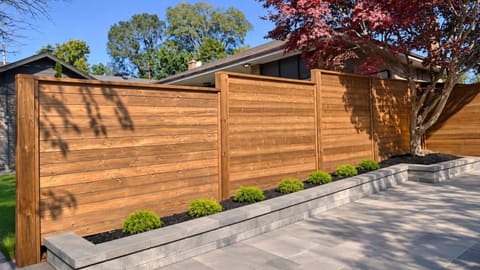
Best Privacy Fence Material for Ontario Winters
Best privacy fence material for Ontario winters: how cedar, composite, aluminum and masonry handle frost, snow and sun, and what to check before you build.
Guide
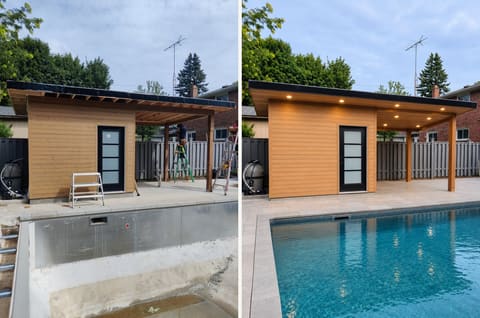
Does a Backyard Upgrade Add Value to a Toronto Home?
Backyard renovation ROI in Toronto: what makes an outdoor upgrade add value, which projects tend to pay back in daily use, and the mistakes that cost you.
Guide
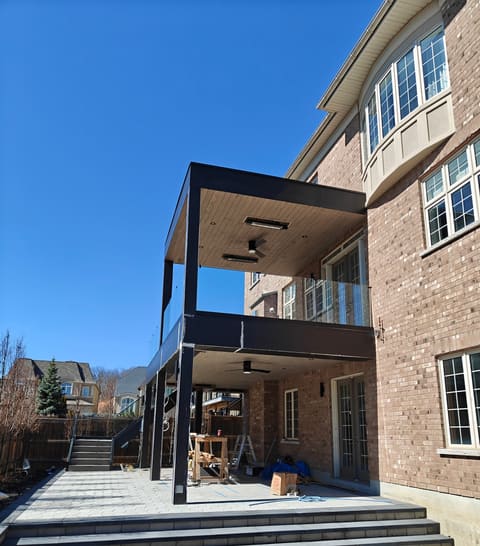
Multi-Level Deck Design for Sloped GTA Lots
Multi level deck design for sloped GTA lots: how to plan levels, steps, guards, footings and drainage so a tiered deck works with your yard. See the checklist.
Guide
Call Before You Dig in Ontario: Locates for Backyard Projects
Call before you dig in Ontario: how Ontario One Call (Ontario Dig Authority) locates work, what private lines they miss, and how to plan. Read the guide.
See also our Landscaping & Hardscaping service.